

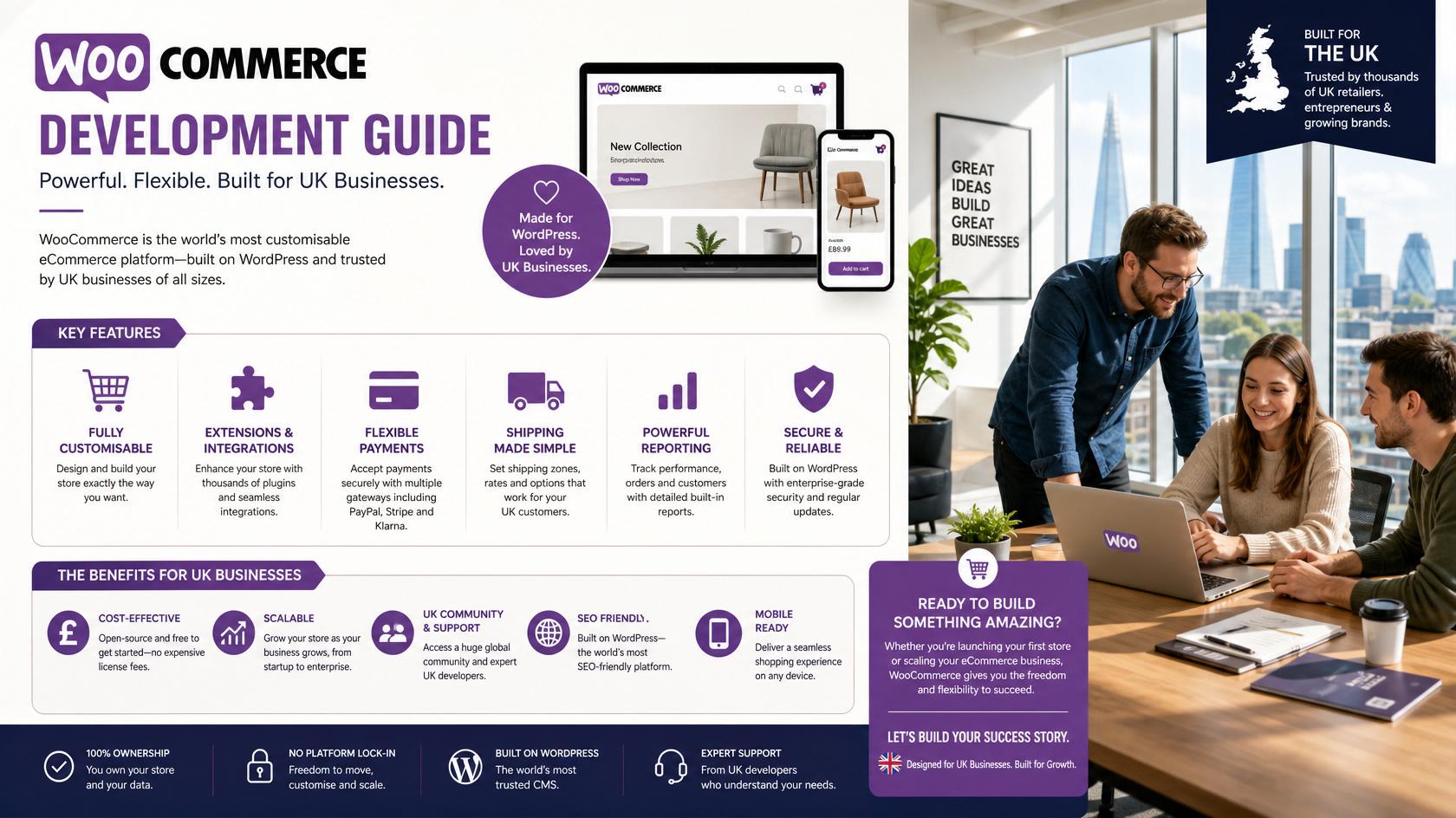
A complete WooCommerce development guide for UK businesses covering website costs, custom development, payment gateways, performance, security, SEO, integrations and how to choose the right WooCommerce development company.
WooCommerce gives UK businesses the flexibility to transform WordPress into a powerful online store, but installing WooCommerce is only the beginning. Building an eCommerce website capable of attracting customers, processing orders efficiently and supporting long-term growth requires careful planning, professional development, security, performance optimisation and SEO.
For businesses researching WooCommerce development in the UK, this guide explains the complete process—from choosing WooCommerce and planning your online store to custom development, payment gateways, shipping, SEO, performance, security, integrations and ongoing maintenance.
WebCOSS provides web development and digital solutions for businesses that need professional websites, WordPress development, custom functionality and scalable eCommerce solutions.
Whether you're launching your first online shop, replacing an outdated store or expanding an established eCommerce business, understanding how WooCommerce works will help you make better technical and commercial decisions.
What Is WooCommerce?
WooCommerce is an open-source eCommerce platform built for WordPress. It adds online-store functionality to a WordPress website, allowing businesses to manage products, customers, orders, payments, shipping and other essential eCommerce processes.
According to the official WooCommerce website, the platform is designed to provide merchants with control over their store while supporting extensions and integrations for additional functionality.
A typical WooCommerce website can include:
-
Physical products
-
Digital products
-
Product categories
-
Product variations
-
Shopping basket
-
Checkout
-
Customer accounts
-
Payment gateways
-
Shipping methods
-
Tax configuration
-
Discount codes
-
Stock management
-
Order management
-
Transactional emails
-
Product reviews
-
Reporting
-
Third-party integrations
Because WooCommerce works within WordPress, businesses can combine their online store with landing pages, blogs, guides, FAQs and other content within the same website.
Why Are UK Businesses Choosing WooCommerce?
Businesses rarely need exactly the same eCommerce setup.
A small specialist retailer might need several dozen products and a straightforward checkout, while a growing company may require thousands of products, advanced variations, custom shipping rules, trade accounts, external inventory systems and business-specific integrations.
WooCommerce provides a flexible foundation that can be adapted to different requirements.
Key benefits include:
-
Open-source architecture
-
Integration with WordPress
-
Flexible product management
-
Extensive customisation possibilities
-
Multiple payment options
-
Configurable shipping
-
SEO-friendly foundations
-
Large extension ecosystem
-
Custom plugin development possibilities
-
Support for content marketing
-
Scalability when correctly developed and hosted
However, flexibility does not mean every plugin or feature should be installed.
Professional WooCommerce website development is about selecting the simplest reliable solution for the business requirement while maintaining performance, security and maintainability.
What Does a WooCommerce Development Company Do?A professional WooCommerce development company in the UK can handle considerably more than installing WordPress and selecting a theme.
Development can involve planning the technical architecture, designing the customer journey, configuring WooCommerce, developing custom functionality, integrating third-party systems and optimising the website for search engines and conversions.
Services may include:
WooCommerce Store Development
Building a new online shop from planning through development, testing and launch.
Custom WooCommerce Development
Developing functionality that standard WooCommerce or existing extensions cannot adequately provide.
WooCommerce Theme Development
Creating or adapting the visual interface to reflect the company's brand while keeping the store responsive and usable.
WooCommerce Plugin Development
Building custom extensions for specialised business requirements.
WooCommerce API Integration
Connecting the online store with external services such as CRM, ERP, accounting, fulfilment, inventory or other business platforms.
WooCommerce Migration
Moving products, customers, orders and other relevant information from an existing eCommerce platform where technically appropriate.
WooCommerce Performance Optimisation
Improving page speed, database efficiency, images, scripts, caching and infrastructure.
WooCommerce Maintenance
Keeping WordPress, WooCommerce and extensions maintained while identifying compatibility or security problems.
Planning a WooCommerce Website for a UK BusinessSuccessful WooCommerce projects should begin with business requirements rather than immediately choosing themes and plugins.
Before development starts, determine:
-
What products will be sold?
-
How many products will the store contain?
-
Are products simple or configurable?
-
Will products have sizes, colours or other variations?
-
Who are the target customers?
-
Will the business sell only in the UK?
-
What payment methods are required?
-
How will delivery work?
-
Is stock managed inside WooCommerce or elsewhere?
-
Are subscriptions required?
-
Are trade or B2B accounts needed?
-
Does the store require customer-specific pricing?
-
Are integrations required?
-
Will existing data need migration?
-
What SEO requirements exist?
-
What reporting is required?
Answering these questions early helps prevent expensive redevelopment later.
Essential Features of a Professional WooCommerce Store1. Responsive eCommerce Design
Customers should be able to browse and purchase comfortably across mobile phones, tablets, laptops and desktop computers.
Responsive WooCommerce development should consider more than shrinking the desktop layout.
Important mobile elements include:
-
Navigation
-
Search
-
Product galleries
-
Product variations
-
Add-to-basket controls
-
Filters
-
Basket
-
Checkout
-
Forms
-
Payment interfaces
-
Account pages
The entire buying journey should remain clear and usable on smaller screens.
2. Professional Product Pages
Product pages are among the most important pages of an eCommerce website.
A strong WooCommerce product page can include:
-
Clear product name
-
Professional product images
-
Price
-
Availability
-
Product variations
-
Useful description
-
Specifications
-
Delivery information
-
Returns information
-
Reviews where appropriate
-
Related products
-
Relevant FAQs
-
Clear call-to-action
Product information should help customers make purchasing decisions rather than being written purely for search engines.
3. Product Categories and Navigation
Customers need to find products quickly.
For larger catalogues, good information architecture becomes increasingly important.
A store might use:
Shop → Main Category → Subcategory → Product
For example:
Shop → Home & Garden → Wall Decorations → Personalised Wall Sign
This type of hierarchy can improve usability while creating meaningful category pages that may also target valuable organic search queries.
WooCommerce Payment Gateway Integration UKA WooCommerce store needs an appropriate payment solution so customers can complete purchases securely.
Depending on the business and chosen provider, payment options might include:
-
Debit cards
-
Credit cards
-
Digital wallets
-
Provider-specific payment methods
Popular providers in the UK WooCommerce ecosystem include Stripe and PayPal.
The right payment setup depends on transaction fees, business requirements, checkout experience, settlement processes and supported payment methods.
Payment information should be processed using established payment providers rather than creating unnecessary custom systems for sensitive card information.
WooCommerce Shipping for UK BusinessesShipping configuration can become one of the most complicated parts of an online shop.
A UK WooCommerce business might require:
-
Free shipping
-
Flat-rate shipping
-
Weight-based shipping
-
Product-specific shipping
-
Postcode-based delivery
-
Local collection
-
Free delivery above an order value
-
Multiple delivery services
-
International delivery
Shipping rules should be planned before development so that the checkout calculates delivery accurately.
Unexpected shipping charges are a common source of checkout friction, so costs and available methods should be communicated clearly.
WooCommerce Stock and Inventory ManagementWooCommerce can manage stock quantities directly, including information such as:
-
SKU
-
Stock quantity
-
Stock status
-
Backorders
-
Product variations
Businesses with more advanced requirements may need their WooCommerce store connected to another inventory or business management system.
When two systems manage the same stock, synchronisation becomes critical.
Poor inventory integration can result in:
-
Overselling
-
Incorrect availability
-
Duplicate data
-
Manual administrative work
-
Customer dissatisfaction
Integration design should therefore define which platform is the authoritative source for each type of information.
Custom WooCommerce DevelopmentStandard WooCommerce functionality is sufficient for many online shops.
Other businesses need functionality tailored to their operations.
Custom WooCommerce development can include:
-
Product configurators
-
Custom pricing
-
Dynamic pricing rules
-
Quote systems
-
Personalisation tools
-
Product builders
-
Customer dashboards
-
Advanced checkout processes
-
Custom order statuses
-
Booking functionality
-
B2B features
-
Trade accounts
-
Wholesale ordering
-
API integrations
-
Automated workflows
The objective should not be to customise everything.
Custom development makes sense when it solves a genuine business requirement more effectively than existing reliable functionality.
WooCommerce Plugin DevelopmentWooCommerce has a large ecosystem of extensions, but installing numerous plugins without evaluating them can create maintenance, performance and compatibility problems.
A custom WooCommerce plugin may be appropriate when a business has specialised requirements.
Examples include:
-
Custom checkout fields
-
Special product pricing logic
-
Bespoke product options
-
Internal system integrations
-
Order workflow automation
-
Custom reporting
-
Business-specific account features
Good custom development should follow WordPress and WooCommerce development practices and avoid unnecessarily modifying core files.
WooCommerce SEO for UK BusinessesA well-designed store cannot generate organic traffic simply because WooCommerce is installed.
WooCommerce SEO requires technical optimisation, keyword research, useful content and a logical site structure.
Important SEO areas include:
-
Keyword research
-
Product page optimisation
-
Category page optimisation
-
Meta titles
-
Meta descriptions
-
Heading structure
-
Internal linking
-
Breadcrumbs
-
Image optimisation
-
Product structured data
-
Canonical URLs
-
XML sitemaps
-
Crawl management
-
Mobile usability
-
Website performance
-
Helpful content
Businesses can also review Google's official Search Central documentation for current guidance about crawling, indexing, structured data and search optimisation.
Keyword Research for WooCommerce StoresNot every keyword should target the homepage.
A well-structured store maps different search intentions to different pages.
For example:
Homepage
May target the overall brand and broad commercial proposition.
Category Pages
Can target product-category purchasing terms.
Product Pages
Can target specific product names and long-tail transactional searches.
Blog and Guides
Can target informational searches customers make before purchasing.
This creates a topic structure rather than forcing unrelated keywords onto one page.
WooCommerce Category Page SEOCategory pages are frequently overlooked.
For many eCommerce websites, category pages have strong ranking potential because they align closely with commercial search intent.
An optimised category page may include:
-
Descriptive H1
-
Relevant introduction
-
Useful product filters
-
Clear products
-
Internal links
-
Supporting content
-
FAQs where genuinely useful
-
Relevant metadata
Avoid stuffing large blocks of repetitive keyword-focused copy around product listings.
The primary purpose of a category page is still to help users find products.
WooCommerce Product Page SEOEach important product page should have useful, distinctive content.
Avoid copying manufacturer descriptions across large numbers of products when unique information can provide additional value.
Optimisation can include:
-
Descriptive product title
-
Search-friendly URL
-
Unique product description
-
Relevant H1
-
Useful specifications
-
Optimised images
-
Descriptive alt text where appropriate
-
Internal links
-
Related products
-
Product structured data
Product pages should primarily answer the customer's purchasing questions.
Technical SEO for WooCommerceWooCommerce websites can generate complex URL structures through:
-
Categories
-
Tags
-
Product attributes
-
Filters
-
Search pages
-
Pagination
-
Tracking parameters
-
Product variations
Without careful management, search engines may discover large numbers of low-value or duplicate URLs.
Technical SEO should therefore review:
-
Crawlability
-
Indexation
-
Canonical tags
-
XML sitemaps
-
Robots directives
-
Duplicate content
-
Redirects
-
Broken links
-
Pagination
-
Structured data
-
Faceted navigation
These considerations become particularly important as the catalogue grows.
WooCommerce Website Speed OptimisationPerformance can affect both customer experience and business results.
A slow WooCommerce store may be caused by:
-
Poor hosting
-
Oversized images
-
Excessive plugins
-
Unoptimised JavaScript
-
Unnecessary CSS
-
Slow database queries
-
Inefficient custom code
-
Third-party scripts
-
Poor caching configuration
Performance optimisation may include:
-
Image compression
-
Modern image formats where appropriate
-
Browser caching
-
Page and object caching strategies
-
Database optimisation
-
Script optimisation
-
CDN implementation where useful
-
Better hosting infrastructure
-
Removing unnecessary plugins
-
Optimising custom queries
Businesses can use PageSpeed Insights to assess performance and Core Web Vitals data.
WooCommerce SecuritySecurity should be considered throughout the lifetime of the store.
Important measures can include:
-
HTTPS
-
Strong administrator authentication
-
Appropriate user permissions
-
Regular WordPress updates
-
WooCommerce updates
-
Plugin and theme updates
-
Backups
-
Secure hosting
-
Input validation
-
Output escaping
-
Protection against common attacks
-
Monitoring
-
Limiting unnecessary administrative access
Plugins should be sourced carefully and unnecessary extensions removed.
Security is an ongoing process, not a one-time installation.
WooCommerce Backup and RecoveryEvery commercial eCommerce website should have a reliable backup strategy.
Backups may need to cover:
-
Website files
-
Database
-
Product data
-
Orders
-
Customer information
-
Configuration
-
Uploaded media
Because WooCommerce databases change frequently as customers place orders, backup frequency should reflect the store's transaction volume.
A backup is useful only when it can actually be restored, so recovery procedures should also be tested appropriately.
WooCommerce IntegrationsGrowing businesses often need WooCommerce to communicate with other platforms.
Possible integrations include:
-
CRM
-
ERP
-
Accounting
-
Inventory management
-
Email marketing
-
Shipping and fulfilment
-
Analytics
-
Customer support
-
Marketplace services
-
Internal business applications
Integrations can reduce repetitive administrative tasks and keep information synchronised.
However, each integration introduces another dependency, so reliability, error handling and data ownership should be planned carefully.
B2B WooCommerce Development UKWooCommerce can also be adapted for business-to-business eCommerce.
A B2B WooCommerce website may require:
-
Trade registration
-
Account approval
-
Wholesale pricing
-
Customer-specific pricing
-
Quantity discounts
-
Minimum order quantities
-
Bulk ordering
-
Quote requests
-
Purchase orders
-
VAT-related functionality
-
Repeat ordering
-
Account-specific catalogues
These projects often require more custom development than a standard consumer store.
WooCommerce Website Development Cost UKOne of the most common questions businesses ask is:
How much does a WooCommerce website cost in the UK?
There is no meaningful universal price because WooCommerce projects vary significantly.
The cost depends on factors such as:
-
Design complexity
-
Number of products
-
Product variations
-
Custom functionality
-
Data migration
-
Payment integrations
-
Shipping rules
-
Third-party integrations
-
B2B requirements
-
SEO
-
Content
-
Testing
-
Hosting
-
Maintenance
A small store using mostly standard functionality is considerably different from a custom eCommerce platform connected to inventory, CRM and accounting systems.
When comparing quotes, businesses should compare project scope rather than price alone.
WooCommerce vs Custom eCommerce DevelopmentWooCommerce is not automatically the right solution for every business.
WooCommerce may be suitable when:
-
The business already uses WordPress
-
Content marketing is important
-
Standard eCommerce functionality covers most requirements
-
The company needs flexible customisation
-
The catalogue is manageable within an appropriate WooCommerce architecture
Custom development may be appropriate when:
-
Business workflows are highly specialised
-
Complex application functionality is required
-
The store has unusual integration requirements
-
WooCommerce would require excessive modification
-
The project is fundamentally more like a web application than a traditional store
The technology should follow the business requirement.
Migrating an Existing Store to WooCommerceBusinesses moving from another platform should plan migration carefully.
Depending on the existing platform, data may include:
-
Products
-
Categories
-
Images
-
Customers
-
Orders
-
Reviews
-
SKUs
-
URLs
-
Metadata
SEO migration is particularly important.
Changing URLs without appropriate redirects can damage existing organic visibility.
A migration plan should therefore map important old URLs to their new destinations and preserve valuable content wherever practical.
WooCommerce Maintenance and SupportWooCommerce websites require ongoing technical attention after launch.
Maintenance can include:
-
WordPress updates
-
WooCommerce updates
-
Plugin updates
-
Theme updates
-
Backups
-
Security monitoring
-
Performance checks
-
Error monitoring
-
Checkout testing
-
Payment testing
-
Compatibility testing
Updates should be managed carefully because a change to WordPress, WooCommerce or an extension can occasionally affect another component of the store.
How to Choose a WooCommerce Development Company in the UKChoosing a developer based only on the cheapest quote can create expensive problems later.
Before hiring a WooCommerce development company, ask:
-
Do they have experience with WooCommerce?
-
Can they develop custom functionality?
-
Do they understand WordPress security?
-
Do they consider technical SEO?
-
Can they optimise performance?
-
Do they understand responsive eCommerce UX?
-
Can they integrate external APIs?
-
How do they test checkout functionality?
-
Do they provide ongoing support?
-
How will custom code be maintained?
A strong development partner should understand the commercial purpose of the website as well as its technical requirements.
Why Choose WebCOSS for WooCommerce Development?WebCOSS provides website development and digital solutions for businesses requiring reliable, scalable online platforms.
For WooCommerce projects, the focus should be on creating an online store that is technically sound while remaining straightforward for customers and administrators.
Depending on project requirements, this can involve:
-
WooCommerce development
-
WordPress development
-
Custom plugin development
-
Custom functionality
-
Responsive web design
-
Payment integrations
-
API integrations
-
Performance optimisation
-
Technical SEO
-
Website maintenance
-
eCommerce support
Instead of adding unnecessary functionality, the development approach should focus on what the business actually needs.
Start Your WooCommerce Project with WebCOSSA successful WooCommerce website needs more than a theme and a collection of plugins.
The store needs to connect product discovery, user experience, checkout, payment, fulfilment, SEO, security and administration into one reliable customer journey.
If you're planning a new WooCommerce store, redesigning an existing website or require custom eCommerce functionality, explore WebCOSS to learn more about web development and digital solutions for UK businesses.
Frequently Asked Questions About WooCommerce DevelopmentCan an existing website be converted to WooCommerce?
In many cases, yes. The migration approach depends on the existing platform and data. Products, customers, orders, URLs and SEO information need to be assessed before migration.
Can WebCOSS develop custom WooCommerce plugins?
Custom WooCommerce functionality can be developed when a business requirement cannot be appropriately addressed using existing functionality. Custom development should be limited to genuine requirements so the store remains maintainable.
Why should SEO be considered during WooCommerce development?
Many technical SEO decisions are built directly into website architecture. URLs, categories, navigation, internal links, structured data, performance and crawlability are easier to address correctly during development than after a large store has already launched.
How can I improve the speed of a WooCommerce website?
Start by identifying the actual bottleneck. Common improvements include better hosting, optimised images, appropriate caching, reducing unnecessary extensions, database optimisation and improving inefficient custom code. Performance should be measured before and after changes.
What should I look for when hiring a WooCommerce developer?
Look for experience with WordPress and WooCommerce, secure coding, custom development, performance, technical SEO, integrations and ongoing maintenance. The developer should also understand your business requirements rather than simply recommending plugins for every feature.
Is custom WooCommerce development worth it?
It can be when custom functionality solves a genuine commercial or operational requirement. Custom development should provide a clear benefit, such as improving customer experience, automating manual work or supporting a workflow that standard functionality cannot adequately handle.
Frequently Asked Questions
Quick answers related to this article.
Is WooCommerce good for SEO?
WooCommerce can provide a strong SEO foundation when the store is correctly structured. Category architecture, product content, metadata, internal links, structured data, canonicalisation, site speed and technical indexation all need appropriate optimisation.
Does a WooCommerce store require regular maintenance?
Yes. WordPress, WooCommerce, themes and plugins receive updates over time. Stores should also be monitored for security, backups, performance, checkout functionality, integrations and compatibility.
What determines monthly website maintenance cost?
Monthly website maintenance requirements depend on website complexity, plugins, custom code, ecommerce functionality, traffic, security, backups, monitoring, development support and integrations. A WooCommerce store generally requires more operational attention than a basic informational website.
What affects WordPress website cost in the UK?
WordPress website cost depends on design complexity, page count, custom functionality, ecommerce requirements, integrations, content migration, SEO and ongoing support. Adding WooCommerce creates additional requirements around products, orders, payments, shipping and checkout.
How much does WooCommerce development cost in the UK?
There is no single WooCommerce development cost suitable for every UK business. Requirements vary according to design, catalogue size, product complexity, integrations, checkout functionality, custom development, migration, SEO and ongoing support. A requirements-based quotation is therefore more meaningful than a generic fixed price.
What is WooCommerce development?
WooCommerce development covers the design, configuration, customisation and technical development of an online store built with WordPress and WooCommerce. It can include custom themes, product functionality, payment gateways, shipping, checkout customisation, API integrations, SEO, performance optimisation and maintenance.
Tell us about your project
Send the key details and WebCOSS will reply with practical next steps.
Need help planning or improving your digital platform?
WebCOSS can help translate your goals into a practical website, ecommerce, SEO or custom software roadmap.