

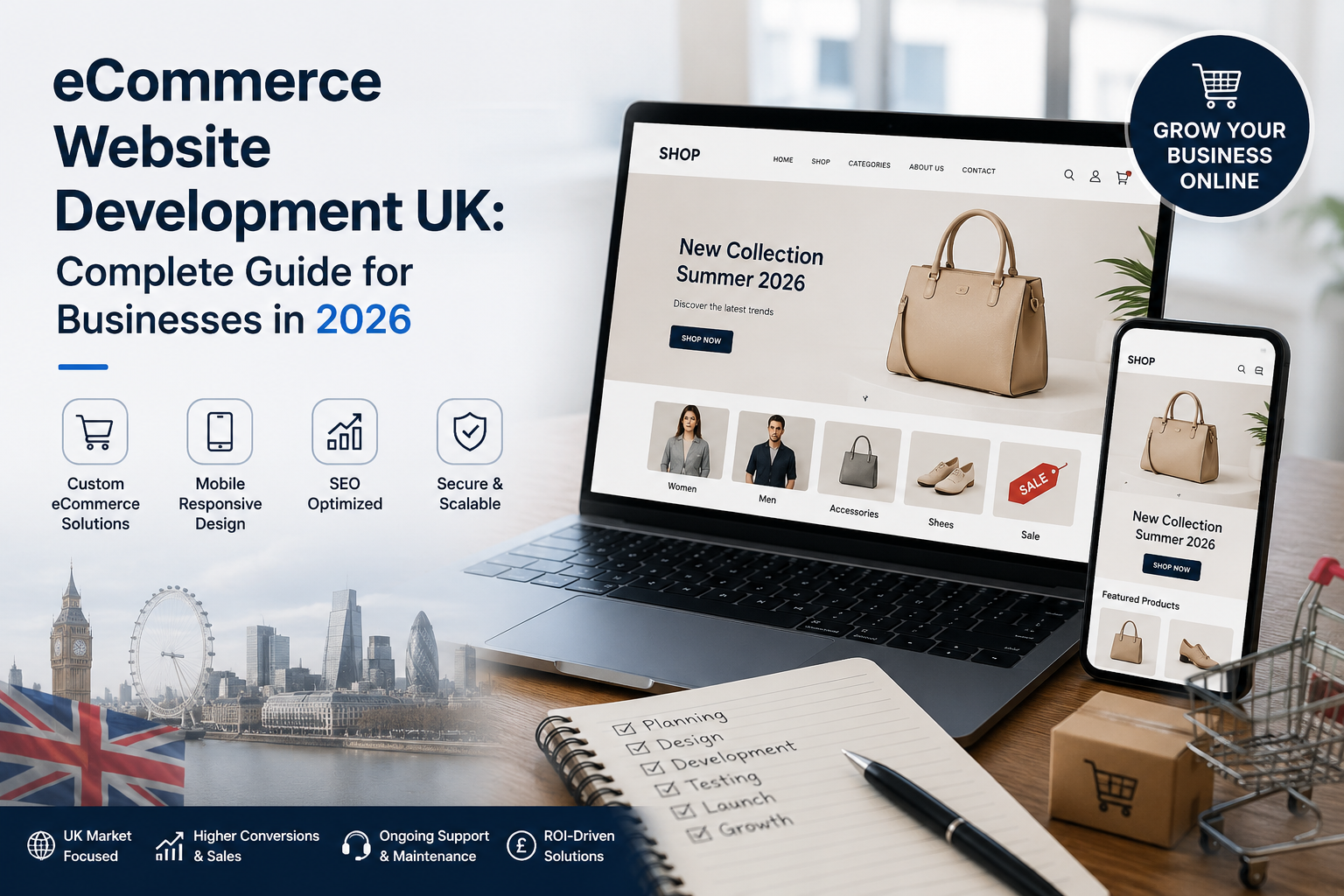
Looking for professional eCommerce website development in the UK? Discover eCommerce costs, platforms, essential features, SEO, security and how WebCOSS builds high-performing online stores.
The UK has one of the world's most established eCommerce markets, making a professional online store an important sales channel for retailers, startups and growing businesses.
But successful eCommerce website development in the UK involves much more than creating product pages and adding a checkout button. Your website needs to be fast, secure, mobile-friendly, easy to manage, optimised for search engines and designed to convert visitors into customers.
At WebCOSS, we develop custom eCommerce websites and online stores for UK businesses with a focus on performance, usability, SEO and long-term scalability.
This guide covers what UK businesses should know before developing or redesigning an eCommerce website, including platforms, features, costs, SEO, security and choosing the right development company.
What Is eCommerce Website Development?
eCommerce website development is the process of designing and building a website that allows businesses to sell products or services online.
A complete eCommerce solution typically includes:
-
Product and category management
-
Shopping basket functionality
-
Secure checkout
-
Online payment integration
-
Customer accounts
-
Order management
-
Stock and inventory management
-
Delivery and shipping options
-
Discount and promotional codes
-
Email notifications
-
Search and product filtering
-
Analytics and conversion tracking
-
Search engine optimisation
The exact functionality required depends on your products, customers and business processes.
Why UK Businesses Need Professional eCommerce Development
An online shop represents your business around the clock.
Customers expect to be able to find products quickly, understand pricing and delivery information, complete purchases securely and use the website comfortably from their phones.
Poor eCommerce experiences can result in abandoned baskets and lost sales.
Professional eCommerce web development focuses on the entire buying journey, from a customer's first Google search through product discovery, checkout and post-purchase communication.
A professionally developed eCommerce website can help you:
-
Sell products 24/7
-
Reach customers throughout the UK
-
Generate organic traffic from Google
-
Improve conversion rates
-
Reduce checkout friction
-
Automate order processing
-
Manage products efficiently
-
Integrate business systems
-
Build customer trust
-
Scale as sales increase
eCommerce Website Development Services in the UK
Different businesses require different levels of functionality.
WebCOSS provides eCommerce development services for UK businesses ranging from new online stores to complex custom eCommerce platforms.
Custom eCommerce Website Development
Off-the-shelf templates are not suitable for every business.
Custom eCommerce development allows the website architecture, customer journey and functionality to be designed around your specific requirements.
This can include custom:
-
Product configurations
-
Pricing rules
-
Checkout processes
-
Customer portals
-
Subscription systems
-
Booking functionality
-
B2B ordering
-
API integrations
-
Inventory workflows
-
Business automation
WooCommerce Development UK
WooCommerce is a popular choice for businesses that want to combine WordPress content management with powerful eCommerce functionality.
Our WooCommerce development services in the UK can include:
-
WooCommerce store development
-
Custom theme development
-
Custom plugin development
-
Payment gateway integration
-
Product variation configuration
-
Shipping configuration
-
Checkout customisation
-
Performance optimisation
-
WooCommerce SEO
-
Existing store redesigns
-
Maintenance and technical support
WooCommerce can work particularly well for businesses that require strong content marketing capabilities alongside their online shop.
Custom Online Store Development
Some businesses have requirements that cannot be handled effectively by a standard eCommerce configuration.
A custom online store can provide greater flexibility for complex products, specialised ordering processes, customer-specific pricing or integration with internal systems.
At WebCOSS, we can develop solutions around your actual business workflow rather than forcing your business to adapt to a restrictive template.
Essential Features of a Modern eCommerce Website
An effective UK eCommerce website should make purchasing as simple as possible.
1. Mobile-Responsive Design
Customers increasingly browse and purchase products using mobile devices.
Your online shop should provide an excellent experience across smartphones, tablets, laptops and desktops.
Navigation, product images, filters, basket controls and checkout fields should all remain easy to use on smaller screens.
2. Fast Website Performance
Speed directly affects user experience.
Large product images, unnecessary scripts, poorly configured plugins and inefficient hosting can make an eCommerce website slow.
Performance optimisation should therefore be considered during development rather than added after launch.
3. Advanced Product Search
Customers should be able to quickly find the products they want.
Depending on your catalogue, this can include:
-
Keyword search
-
Category filters
-
Price filters
-
Brand filters
-
Size and colour filters
-
Availability filters
-
Sorting options
4. Secure Payment Gateway Integration
A professional eCommerce website needs a reliable and secure payment process.
Depending on business requirements, stores may support payment methods such as debit and credit cards, digital wallets and other appropriate payment providers.
5. Simple Checkout Process
Every unnecessary checkout step creates another opportunity for a customer to leave.
A well-designed checkout should clearly communicate:
-
Product information
-
Order total
-
Delivery costs
-
Available delivery methods
-
Payment options
-
Required customer information
6. Product and Inventory Management
Store owners need a straightforward way to add and update:
-
Products
-
Prices
-
Images
-
Categories
-
Variations
-
SKUs
-
Stock quantities
-
Offers
For larger businesses, inventory can also be synchronised with external systems through integrations.
7. Customer Account Management
Customer accounts can allow buyers to:
-
Review previous orders
-
Track current orders
-
Save addresses
-
Update account information
-
Reorder products
The functionality should be selected according to the needs of the store rather than added unnecessarily.
eCommerce SEO: Getting Your Products Found on Google
Building an online shop does not automatically generate traffic.
eCommerce SEO in the UK helps search engines understand your products, categories and website structure.
A strong SEO foundation should begin during development.
Important eCommerce SEO elements include:
-
SEO-friendly URLs
-
Optimised category pages
-
Unique product descriptions
-
Keyword-focused page titles
-
Meta descriptions
-
Correct heading hierarchy
-
Product structured data
-
Breadcrumbs
-
Internal linking
-
Canonical URLs
-
XML sitemaps
-
Image optimisation
-
Alt text
-
Mobile optimisation
-
Core Web Vitals
-
Page speed
-
Indexation management
Product Page SEO
Product pages should provide useful information to both shoppers and search engines.
Instead of relying entirely on manufacturer descriptions, important products should have unique, useful content covering their features, benefits, specifications and relevant purchasing information.
A strong product page may contain:
-
Unique product title
-
Detailed description
-
High-quality images
-
Price
-
Availability
-
Specifications
-
Variations
-
Delivery information
-
Reviews where appropriate
-
Related products
-
Relevant FAQs
eCommerce Category Page SEO
Category pages can be extremely valuable organic search landing pages.
For example, rather than trying to rank every page for broad terms such as "buy online", category pages can target more specific product searches with stronger purchase intent.
An optimised category page should combine useful product navigation with relevant supporting content without making customers scroll through unnecessary text before reaching products.
Technical SEO for eCommerce Websites
Large eCommerce websites can create significant technical SEO challenges.
Filters, product variations, pagination and tracking parameters can potentially generate large numbers of similar URLs.
Technical SEO should therefore consider:
-
Crawlability
-
Indexation
-
Canonicalisation
-
Duplicate content
-
Faceted navigation
-
Redirects
-
Broken links
-
Pagination
-
Structured data
-
XML sitemaps
-
Robots directives
Getting the technical structure right during development is usually easier than correcting thousands of problematic URLs later.
How Much Does an eCommerce Website Cost in the UK?
There is no single fixed eCommerce website development cost in the UK.
The price depends on the complexity and requirements of the project.
Important cost factors include:
-
Number of products
-
Platform
-
Payment integrations
-
Shipping requirements
-
Product variations
-
Custom functionality
-
Third-party integrations
-
B2B functionality
-
Multilingual requirements
-
SEO requirements
-
Data migration
-
Ongoing maintenance
A small online shop and a custom eCommerce platform with thousands of products, integrations and business-specific workflows are fundamentally different projects.
For this reason, businesses should request a quote based on clearly defined requirements rather than selecting a development company solely on the lowest advertised price.
Custom eCommerce Development vs Template Website
Templates can reduce initial development time, but they can also introduce limitations.
Template-Based eCommerce
This may be suitable for:
-
Smaller product catalogues
-
Standard purchasing journeys
-
New businesses
-
Straightforward functionality
Custom eCommerce Development
This may be more appropriate for:
-
Complex product configurations
-
Unique checkout requirements
-
B2B eCommerce
-
Customer-specific pricing
-
Custom integrations
-
Large catalogues
-
Special business workflows
-
Long-term scalability requirements
The right approach depends on the business rather than simply choosing whichever technology is currently popular.
B2B eCommerce Website Development
Business-to-business eCommerce often requires functionality that differs from consumer retail.
A B2B eCommerce platform may require:
-
Trade customer accounts
-
Wholesale pricing
-
Customer-specific prices
-
Minimum order quantities
-
Bulk ordering
-
Quote requests
-
Purchase orders
-
VAT handling
-
Account approval
-
Repeat ordering
-
ERP or CRM integrations
Custom development can help connect these requirements into a streamlined ordering process.
eCommerce Website Security
Security is particularly important for online stores because they process customer and transaction-related information.
Development should follow secure coding and platform practices, including:
-
HTTPS
-
Secure authentication
-
Access controls
-
Software updates
-
Input validation
-
Database security
-
Regular backups
-
Spam protection
-
Appropriate payment integration
-
Security monitoring
Security is an ongoing responsibility rather than a one-time launch task.
eCommerce Website Maintenance and Support
Launching the website is only the beginning.
An online store requires ongoing attention to remain secure, reliable and competitive.
Maintenance can include:
-
Software updates
-
Security monitoring
-
Backup management
-
Performance monitoring
-
Bug fixes
-
Compatibility testing
-
SEO monitoring
-
Feature improvements
Businesses should establish responsibility for ongoing maintenance before launching their store.
Choosing an eCommerce Development Company in the UK
Your development partner can have a significant impact on the long-term success of your online store.
Before choosing an eCommerce development company in the UK, consider whether the company understands:
-
Your business objectives
-
eCommerce user experience
-
Mobile-first development
-
Technical SEO
-
Website security
-
Conversion optimisation
-
Payment integration
-
Performance optimisation
-
Custom functionality
-
Long-term maintenance
The cheapest quote is not necessarily the most cost-effective solution.
A poorly developed website can result in additional costs through lost sales, technical problems and expensive redevelopment.
Why Choose WebCOSS for eCommerce Website Development?
WebCOSS provides professional website and eCommerce development services for UK businesses.
We focus on creating websites that combine design, development, usability, performance and SEO rather than treating each area separately.
Our eCommerce development approach focuses on:
-
Business-specific requirements
-
Responsive UI/UX
-
Fast performance
-
Secure development
-
SEO-friendly architecture
-
Scalable functionality
-
Clean product navigation
-
Conversion-focused customer journeys
-
Custom integrations where required
-
Ongoing technical support
Whether you need to launch your first online shop, redesign an existing eCommerce website or develop custom functionality, we can build a solution around your requirements.
Start Your UK eCommerce Project with WebCOSS
Your eCommerce website should do more than display products. It should help customers discover what they need, build confidence in your business and make purchasing simple.
If you're looking for an eCommerce website development company in the UK, WebCOSS can help you plan, design and develop a scalable online store tailored to your business.
Discuss your eCommerce project with WebCOSS:
Visit WebCOSS
Frequently Asked Questions
Quick answers related to this article.
Can WebCOSS build a custom eCommerce website?
Yes. WebCOSS develops custom eCommerce solutions for businesses that require functionality beyond a standard online-store setup, including custom workflows, integrations, customer portals and business-specific purchasing processes.
Do eCommerce websites need ongoing maintenance?
Yes. eCommerce websites require regular software updates, backups, security checks, performance monitoring and compatibility testing. Ongoing maintenance reduces security and reliability risks as technologies and integrations change.
Can you redesign an existing eCommerce website?
Yes. An existing online shop can be redesigned to improve its appearance, mobile usability, performance, navigation, SEO and conversion journey while preserving important product and customer data where technically appropriate.
Can an eCommerce website rank on Google?
Yes. eCommerce websites can generate substantial organic search traffic when product pages, categories, technical SEO, internal linking, site performance and content are properly optimised. SEO should ideally be considered during development.
How long does it take to develop an eCommerce website?
Development time varies according to complexity. Product quantity, custom design, integrations, data migration, checkout requirements and custom functionality can all affect the project schedule.
Is WooCommerce good for UK businesses?
WooCommerce can be an effective solution for many UK businesses, particularly companies already using WordPress or requiring strong control over website content. Correct hosting, development, security and performance optimisation are important as the store grows.
Which platform is best for an eCommerce website?
There is no single best platform for every business. WooCommerce can be suitable for WordPress-based stores, while businesses with specialised workflows may benefit from custom development. The decision should consider product catalogue size, functionality, integrations, scalability and ongoing management.
How much does it cost to build an eCommerce website in the UK?
The cost depends on the platform, number of products, design requirements, payment systems, integrations and custom functionality. A simple online store costs considerably less than a custom B2B or enterprise eCommerce platform. Requesting a requirements-based quotation provides a more meaningful estimate.
Tell us about your project
Send the key details and WebCOSS will reply with practical next steps.
Need help planning or improving your digital platform?
WebCOSS can help translate your goals into a practical website, ecommerce, SEO or custom software roadmap.