

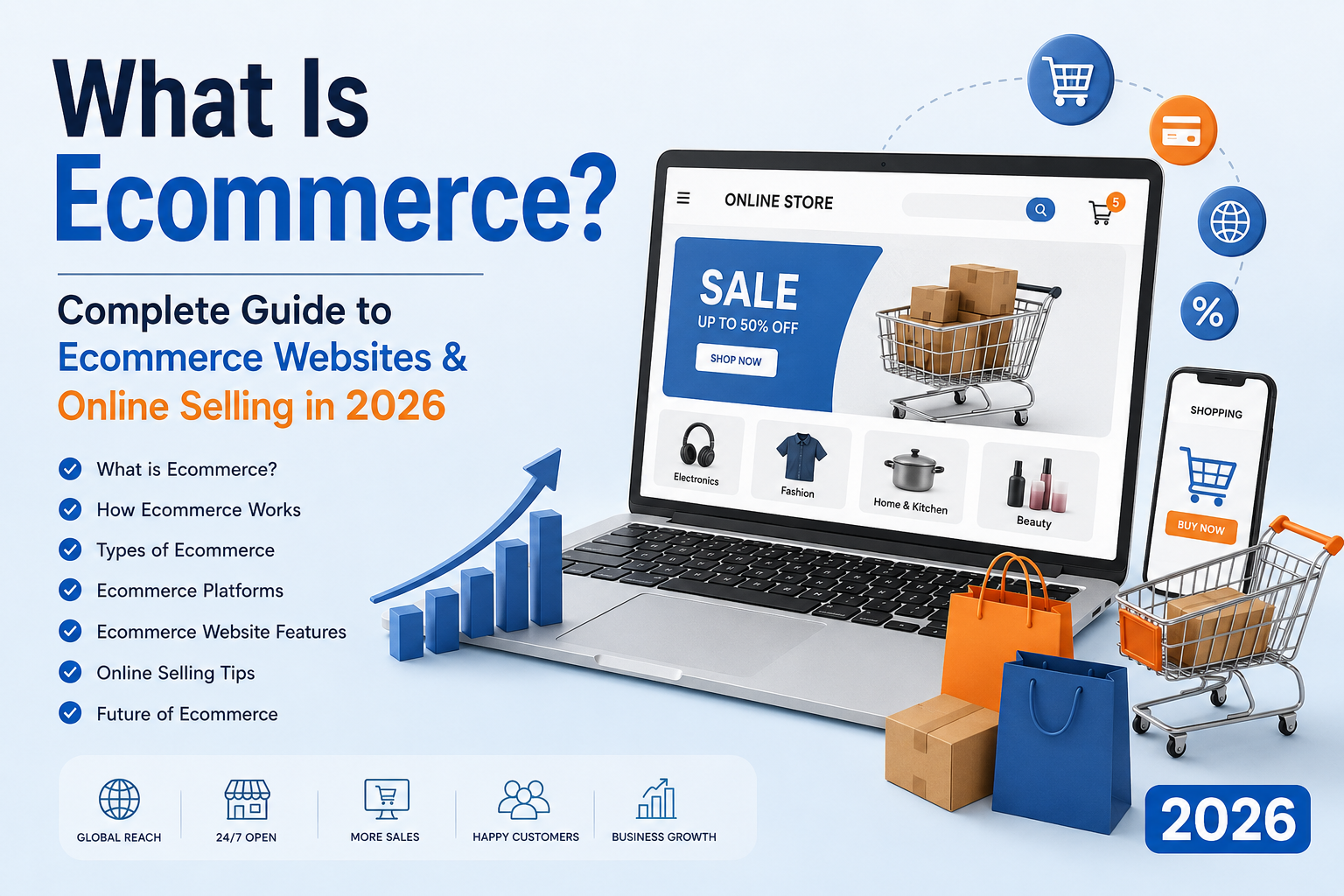
What is ecommerce and how does it work? Explore ecommerce websites, business models, platforms, payments, SEO, security, marketing and development in this complete 2026 guide.
Ecommerce has transformed how businesses sell products and services and how customers discover, compare and purchase them.
From a small independent retailer selling products through an online shop to a manufacturer operating a B2B ordering portal, ecommerce can support many different types of digital transactions.
But what is ecommerce, how does ecommerce work, and what does a business need to build a successful ecommerce website?
Ecommerce, or electronic commerce, is the buying and selling of products or services through digital channels, primarily the internet. An ecommerce website allows customers to browse products or services, make selections, complete transactions and interact with a business online.
Modern ecommerce extends far beyond a basic online shop. It can involve payment processing, inventory management, shipping, customer accounts, marketing automation, analytics, search engine optimisation, CRM systems, ERP integrations, subscriptions, B2B ordering and custom business workflows.
At WebCOSS, we help businesses develop websites, ecommerce stores and custom web solutions designed around their digital and operational requirements.
This complete guide explains ecommerce from the ground up.
What Does Ecommerce Mean?
Ecommerce is short for electronic commerce.
In simple terms, ecommerce refers to commercial transactions that take place electronically.
A customer might:
-
Find a business through Google or another digital channel.
-
Visit its ecommerce website.
-
Search or browse products.
-
View product information.
-
Select product options.
-
Add an item to their basket.
-
Enter delivery information.
-
Select an available payment method.
-
Complete the order.
-
Receive an order confirmation.
-
Track delivery or access the purchased service.
Behind this relatively simple customer experience can be a complex collection of technologies and business processes.
What Is an Ecommerce Website?An ecommerce website is a website designed to facilitate online commercial transactions.
Unlike a conventional informational business website, an ecommerce website usually contains functionality for managing products, customers, orders and transactions.
A typical ecommerce website can include:
-
Homepage
-
Product categories
-
Product pages
-
Product search
-
Product filters
-
Shopping basket
-
Checkout
-
Customer accounts
-
Payment gateway integration
-
Delivery options
-
Order management
-
Stock management
-
Promotional functionality
-
Reviews
-
Wishlist
-
Related products
-
Email notifications
-
Analytics
-
Ecommerce SEO functionality
The exact features should depend on the needs of the business.
How Does Ecommerce Work?Although customers experience ecommerce through a website or application, several systems may work together behind the scenes.
Step 1: Customer Visits the Ecommerce Website
A visitor can reach an online store through channels such as:
-
Google organic search
-
Paid search
-
Social media
-
Email marketing
-
Direct traffic
-
Referral websites
-
Online advertising
-
Content marketing
The ecommerce website then needs to help that visitor find relevant products efficiently.
Step 2: Customer Discovers a Product
Product discovery may happen through:
-
Website navigation
-
Category pages
-
Search
-
Filters
-
Recommendations
-
Featured products
-
Related products
-
Landing pages
Large ecommerce websites need particularly strong search and filtering because customers may otherwise struggle to navigate extensive catalogues.
Step 3: Customer Reviews Product Information
A product page should provide enough information for the customer to make an informed decision.
Depending on the product, this may include:
-
Product name
-
Images
-
Description
-
Features
-
Specifications
-
Variations
-
Availability
-
Delivery information
-
Reviews
-
FAQs
-
Related products
Step 4: Product Is Added to the Basket
The shopping basket records the customer's selected products and quantities.
More advanced ecommerce stores may also support product configurations, bundles, subscriptions, personalisation or other specialised purchasing options.
Step 5: Customer Proceeds to Checkout
The checkout collects the information required to complete the transaction.
This can include:
-
Contact information
-
Billing details
-
Delivery address
-
Delivery method
-
Payment method
-
Relevant customer preferences
A complicated checkout can create unnecessary friction, so good ecommerce development aims to keep the process clear and efficient.
Step 6: Payment Is Processed
The ecommerce platform communicates with an appropriate payment provider to process the transaction.
Sensitive payment information should be handled using secure and established payment infrastructure rather than insecure custom implementations.
Step 7: Order Is Created
Once the appropriate transaction process is completed, the ecommerce system can:
-
Create the order
-
Update stock
-
Notify the customer
-
Notify the business
-
Send information to connected systems
-
Begin fulfilment processes
Step 8: Fulfilment and Delivery
Physical products may then move into packing and delivery.
Digital products or services may instead provide immediate or controlled digital access.
Step 9: Post-Purchase Experience
The customer relationship should not necessarily end at checkout.
Post-purchase functionality can include:
-
Order updates
-
Delivery tracking
-
Customer support
-
Review requests
-
Account management
-
Reordering
-
Relevant marketing communication
Ecommerce businesses can be grouped according to who is buying and who is selling.
B2C Ecommerce – Business to Consumer
B2C ecommerce occurs when a business sells directly to individual consumers.
Examples include:
-
Fashion stores
-
Electronics retailers
-
Beauty brands
-
Gift stores
-
Furniture retailers
-
Food businesses
-
Specialist online shops
This is the ecommerce model most consumers encounter regularly.
B2B Ecommerce – Business to Business
B2B ecommerce involves transactions between businesses.
B2B platforms can require functionality such as:
-
Trade accounts
-
Wholesale ordering
-
Bulk purchasing
-
Account approval
-
Customer-specific catalogues
-
Quantity rules
-
Custom pricing structures
-
Quote requests
-
Repeat ordering
-
Purchase-order workflows
B2B ecommerce development can therefore be significantly different from conventional retail ecommerce.
C2C Ecommerce – Consumer to Consumer
Consumer-to-consumer ecommerce enables individuals to sell products or services to other individuals through a digital marketplace.
The marketplace typically provides the technology connecting buyers and sellers.
C2B Ecommerce – Consumer to Business
In a consumer-to-business model, an individual provides products, content or services to a business.
Freelance and creator-based platforms can operate partly through this model.
D2C Ecommerce – Direct to Consumer
Direct-to-consumer ecommerce allows brands and manufacturers to sell directly to customers rather than relying entirely on traditional intermediaries.
A D2C ecommerce strategy can give a business greater control over:
-
Brand presentation
-
Customer experience
-
Product information
-
Customer relationships
-
Digital marketing
Traditional commerce generally requires customers to interact with a physical location or offline sales process.
Ecommerce enables much of the purchasing journey to happen digitally.
Traditional Commerce
Customers may:
-
Visit a physical store
-
Speak with staff
-
View products physically
-
Complete the transaction in person
Ecommerce
Customers can:
-
Browse products online
-
Compare options
-
Search categories
-
Read product information
-
Complete purchases digitally
-
Access their account online
-
Track orders
Many businesses now combine both approaches through an omnichannel strategy.
Ecommerce vs E-Business: What's the Difference?The terms are related but aren't necessarily identical.
Ecommerce primarily refers to electronic commercial transactions.
E-business can describe a wider range of digital business processes, including:
-
Customer management
-
Internal systems
-
Supplier management
-
Business automation
-
Digital communication
-
Inventory systems
Ecommerce can therefore form one part of a wider digital business strategy.
What Can You Sell Through Ecommerce?Ecommerce isn't limited to physical retail products.
Businesses can sell many different types of products and services online.
Physical Products
Examples include:
-
Clothing
-
Jewellery
-
Furniture
-
Gifts
-
Electronics
-
Homeware
-
Beauty products
-
Printed products
Physical ecommerce generally requires inventory and fulfilment processes.
Digital Products
Examples can include:
-
Digital downloads
-
Templates
-
Digital resources
-
Licensed content
Digital ecommerce may automatically provide access after the required transaction process.
Services
Businesses can also use ecommerce functionality to sell or arrange services.
Depending on the business model, customers may be able to select a service, provide requirements, book availability or complete a transaction online.
Subscriptions
Subscription ecommerce provides recurring access to products or services according to a defined schedule or membership structure.
B2B Products and Services
Manufacturers, wholesalers and distributors can use ecommerce to streamline trade ordering and account management.
What Is an Ecommerce Platform?An ecommerce platform provides the technology required to operate an online store.
It can handle areas such as:
-
Products
-
Categories
-
Orders
-
Customers
-
Basket
-
Checkout
-
Payments
-
Inventory
-
Extensions and integrations
Different platforms offer different levels of flexibility and control.
Popular Ecommerce PlatformsWooCommerce
WooCommerce is an open-source ecommerce platform built for WordPress.
It is particularly useful for businesses that want WordPress content management combined with ecommerce functionality.
WooCommerce can support:
-
Physical products
-
Digital products
-
Product variations
-
Orders
-
Customer accounts
-
Payment integrations
-
Shipping
-
Extensions
-
APIs
-
Custom development
Because WooCommerce is extensible, developers can customise stores for business-specific requirements.
Shopify
Shopify is a hosted commerce platform that provides businesses with infrastructure for creating and operating online stores.
It can be suitable for businesses that prefer a hosted ecosystem with themes, applications and built-in commerce functionality.
Adobe Commerce
Adobe Commerce is aimed at organisations requiring more advanced commerce capabilities and enterprise-level functionality.
Custom Ecommerce Platforms
Some businesses require functionality that doesn't fit efficiently into a standard platform.
Custom ecommerce development may be considered for:
-
Specialised product configurators
-
Complex B2B systems
-
Unique customer portals
-
Advanced business workflows
-
Custom ordering processes
-
Specialist integrations
-
Bespoke marketplaces
The correct platform depends on business requirements rather than simply selecting the most recognisable name.
What Is WooCommerce?WooCommerce transforms WordPress into an ecommerce platform.
It provides core ecommerce functionality while retaining the content management capabilities of WordPress.
This combination can be useful for businesses that depend on both ecommerce and content marketing.
At WebCOSS, WooCommerce projects can be customised around the store's products, customer journey, integrations and business requirements.
Ecommerce Website DesignGood ecommerce website design is about more than appearance.
The interface needs to help customers move efficiently from product discovery to purchase.
Important design areas include:
-
Navigation
-
Category hierarchy
-
Search
-
Filters
-
Product cards
-
Product pages
-
Basket
-
Checkout
-
Mobile experience
-
Calls to action
-
Typography
-
Product photography
-
Accessibility
A visually impressive store that makes products difficult to find can still provide a poor ecommerce experience.
Ecommerce Website DevelopmentEcommerce website development is the technical work involved in creating and maintaining an online store.
Development can include:
-
Front-end development
-
Back-end development
-
Database development
-
Ecommerce platform configuration
-
Custom functionality
-
Payment integration
-
Shipping integration
-
API development
-
Third-party integrations
-
Search
-
Customer accounts
-
Security
-
Performance optimisation
-
Technical SEO
A professional ecommerce developer needs to consider both what customers see and how the underlying system operates.
Custom Ecommerce DevelopmentStandard functionality is sufficient for many online stores.
Other businesses require a more specialised solution.
Custom ecommerce development can provide functionality such as:
-
Product configurators
-
Customer-specific dashboards
-
B2B ordering
-
Trade accounts
-
Custom checkout processes
-
Bespoke product rules
-
Subscription workflows
-
Custom reporting
-
CRM integration
-
ERP integration
-
Inventory integration
-
API connections
-
Business automation
Customisation should solve a genuine business requirement rather than add complexity unnecessarily.
What Is Ecommerce SEO?Ecommerce SEO is the process of improving an online store's visibility in organic search results.
It can involve optimising:
-
Product pages
-
Category pages
-
Website architecture
-
Internal linking
-
Metadata
-
Content
-
Images
-
Structured data
-
Technical SEO
-
Website performance
For ecommerce businesses, organic search can connect customers directly with categories and products they are already looking for.
Ecommerce Keyword ResearchKeyword research identifies how potential customers search for products and related information.
An ecommerce keyword strategy can include:
Product Keywords
Searches for specific products.
Category Keywords
Broader searches describing groups of products.
Commercial Keywords
Queries showing strong purchasing or comparison intent.
Informational Keywords
Questions customers research before making a purchasing decision.
Long-Tail Ecommerce Keywords
More specific searches that may have lower volume but stronger relevance.
For example, a generic product phrase may be highly competitive, while a detailed query describing a particular product type, feature and use case may better reflect what a customer actually wants.
Ecommerce Category Page SEOCategory pages can be some of the most valuable organic landing pages on an online store.
A well-optimised category page can include:
-
Clear H1
-
Relevant introductory content
-
Product listings
-
Useful filtering
-
Internal links
-
Optimised title
-
Meta description
-
Breadcrumbs
-
Supporting information
Content should complement the shopping experience rather than bury products beneath unnecessary SEO text.
Ecommerce Product Page SEOProduct pages should be unique, informative and useful.
Important elements can include:
-
Descriptive product title
-
Unique product description
-
Product images
-
Specifications
-
Features and benefits
-
Availability
-
Product variations
-
Delivery information
-
Reviews
-
Related products
-
FAQs
-
Structured data where appropriate
Avoid simply copying identical manufacturer descriptions when meaningful original information can be provided.
Technical SEO for Ecommerce WebsitesEcommerce websites can create technical SEO challenges because filters, search parameters, product variations and pagination may generate many URLs.
Technical SEO should consider:
-
Crawlability
-
Indexability
-
Canonical URLs
-
Duplicate content
-
XML sitemaps
-
Robots directives
-
Redirects
-
Broken links
-
Faceted navigation
-
Pagination
-
Structured data
-
Core Web Vitals
These considerations become increasingly important as the product catalogue grows.
For official search guidance, businesses and developers can consult Google Search Central.
Ecommerce Website StructureA clear site architecture helps both customers and search engines understand the store.
A typical structure might look like:
Homepage → Main Category → Subcategory → Product
For example:
Home → Furniture → Office Furniture → Office Chair
The architecture should remain logical and avoid creating unnecessary levels between customers and important products.
Ecommerce Internal LinkingInternal links help distribute users and search engines throughout the website.
Useful ecommerce internal links can connect:
-
Homepage to categories
-
Categories to subcategories
-
Categories to products
-
Products to related products
-
Blog posts to categories
-
Guides to relevant products
-
FAQs to service or support pages
A strong content strategy can therefore support commercial ecommerce pages rather than existing separately from them.
Ecommerce Content MarketingBlogs, guides and resources can answer questions customers research before purchasing.
Useful ecommerce content can include:
-
Buying guides
-
Product comparisons
-
How-to guides
-
Product care guides
-
Industry information
-
FAQs
-
Gift guides
-
Trend articles
Content should ultimately help customers make better decisions.
Ecommerce Payment GatewaysA payment gateway helps facilitate online payments between customers and businesses.
An ecommerce website may support:
-
Card payments
-
Digital wallets
-
Alternative payment methods
-
Recurring payments where appropriate
The available methods depend on the platform, payment provider, business and target customers.
Payment security should be treated as a core ecommerce requirement.
Ecommerce Checkout OptimisationCheckout is one of the most important stages of an ecommerce journey.
Common checkout principles include:
-
Keep unnecessary fields to a minimum
-
Clearly show the order
-
Clearly explain delivery options
-
Provide appropriate payment options
-
Display understandable validation errors
-
Optimise forms for mobile
-
Avoid unexpected interruptions
-
Maintain secure processing
Every unnecessary barrier can make completing an order harder.
Ecommerce Inventory ManagementInventory management helps businesses understand what products are available.
Depending on the system, ecommerce inventory functionality can include:
-
SKU management
-
Stock quantities
-
Low-stock alerts
-
Product availability
-
Variation stock
-
Multiple locations
-
Warehouse integration
Larger businesses may connect ecommerce inventory with external operational systems.
Ecommerce Shipping and FulfilmentPhysical ecommerce requires a process for delivering products to customers.
Shipping functionality may depend on:
-
Location
-
Weight
-
Product dimensions
-
Delivery method
-
Product type
-
Customer type
-
Stock location
The website may also integrate with fulfilment or courier services where appropriate.
Ecommerce CRM IntegrationA Customer Relationship Management (CRM) system can help businesses organise customer and sales information.
Connecting ecommerce with CRM functionality can help streamline areas such as:
-
Customer records
-
Sales activity
-
Support
-
Marketing
-
Account management
The exact benefits depend on how the business operates.
Ecommerce ERP IntegrationAn Enterprise Resource Planning (ERP) system may manage operational areas such as inventory, purchasing, accounting or fulfilment.
Integrating ecommerce with an ERP can reduce duplicate data entry and improve synchronisation between the online store and internal business systems.
Ecommerce API IntegrationAn API allows different systems to exchange data.
Ecommerce API integrations can connect a store with:
-
Payment services
-
Delivery systems
-
CRM platforms
-
ERP systems
-
Inventory tools
-
Accounting platforms
-
Marketing tools
-
External applications
API quality and documentation can significantly affect the complexity of an integration.
Ecommerce SecuritySecurity is essential for every ecommerce business.
Important practices can include:
-
HTTPS
-
Secure authentication
-
Strong administrator access
-
Appropriate permissions
-
Server-side validation
-
Input sanitisation
-
Secure API handling
-
Platform updates
-
Extension updates
-
Backups
-
Monitoring
-
Spam protection
-
Secure payment integrations
Security isn't a one-time task completed when a website launches.
It requires ongoing maintenance.
Ecommerce Website PerformanceA slow online shop can negatively affect usability.
Performance issues can be caused by:
-
Large images
-
Excessive JavaScript
-
Too many extensions
-
Inefficient database queries
-
Poor hosting
-
Unoptimised themes
-
Third-party scripts
Performance optimisation can involve:
-
Image compression
-
Modern image formats
-
Caching
-
Database optimisation
-
Code optimisation
-
Appropriate hosting
-
CDN implementation where suitable
Google's Core Web Vitals are measurements related to aspects of real-world page experience, including loading, responsiveness and visual stability.
Ecommerce developers should pay attention to areas such as:
-
Hero images
-
Product galleries
-
Dynamic product interfaces
-
JavaScript
-
Layout shifts
-
Third-party scripts
More information is available through Google Search Central.
Mobile EcommerceMobile usability should be considered from the beginning of an ecommerce project.
Important mobile areas include:
-
Navigation
-
Search
-
Filters
-
Product images
-
Product options
-
Add-to-basket buttons
-
Basket
-
Checkout
-
Forms
-
Account pages
Mobile design should prioritise usability rather than simply shrinking the desktop layout.
Ecommerce AccessibilityAn accessible ecommerce website can serve a wider range of users.
Important considerations include:
-
Keyboard accessibility
-
Alternative text
-
Form labels
-
Focus indicators
-
Logical headings
-
Colour contrast
-
Accessible error messages
-
Descriptive buttons and links
The Web Content Accessibility Guidelines provide internationally recognised guidance for web accessibility.
Ecommerce AnalyticsAnalytics can help businesses understand what customers do on their websites.
Relevant ecommerce measurements can include:
-
Traffic
-
Product views
-
Searches
-
Add-to-basket activity
-
Checkout activity
-
Completed transactions
-
Landing pages
-
Traffic sources
-
Customer journeys
Businesses should collect and use analytics in accordance with applicable privacy requirements.
Ecommerce Conversion Rate OptimisationConversion rate optimisation (CRO) aims to improve how effectively a website helps relevant visitors complete desired actions.
Ecommerce CRO can examine:
-
Product pages
-
Navigation
-
Search
-
Filters
-
Calls to action
-
Product imagery
-
Trust information
-
Delivery information
-
Basket
-
Checkout
-
Mobile usability
Good conversion optimisation is based on evidence rather than simply adding more visual elements.
Ecommerce PersonalisationPersonalisation can tailor aspects of the shopping experience according to relevant customer information or behaviour.
Examples can include:
-
Product recommendations
-
Recently viewed products
-
Account-specific content
-
Relevant promotions
-
Customer-specific catalogues
Personalisation should be implemented carefully and with appropriate privacy considerations.
Ecommerce MarketingBuilding an online store does not automatically guarantee visitors or sales.
Ecommerce marketing can combine multiple channels.
Search Engine Optimisation
SEO helps products and categories become discoverable through organic search.
Content Marketing
Useful guides and articles can attract customers earlier in the purchasing journey.
Email Marketing
Email can support appropriate customer communication, product updates and retention strategies.
Social Media Marketing
Social platforms can help businesses build awareness and showcase products.
Paid Advertising
Paid search and social advertising can provide additional customer acquisition channels when managed effectively.
The right mix depends on the business and its audience.
Ecommerce and Social CommerceSocial commerce connects product discovery and shopping experiences with social media platforms.
Businesses can use social channels to:
-
Showcase products
-
Build brand awareness
-
Share customer content
-
Promote campaigns
-
Direct customers toward ecommerce pages
The website should remain a strong owned digital asset even when third-party platforms form part of the acquisition strategy.
B2B Ecommerce DevelopmentB2B ecommerce often requires specialised functionality.
This can include:
-
Trade accounts
-
Customer approval
-
Wholesale ordering
-
Bulk ordering
-
Quantity rules
-
Custom catalogues
-
Quote requests
-
Purchase orders
-
Repeat ordering
-
CRM integration
-
ERP integration
WebCOSS can develop custom web functionality where a standard consumer ecommerce setup does not fit the business process.
D2C EcommerceDirect-to-consumer ecommerce enables brands to build a direct digital relationship with their customers.
A D2C website can provide greater control over:
-
Branding
-
Product presentation
-
Customer experience
-
Content
-
Customer communication
A successful D2C strategy still requires strong operations, customer service, fulfilment and marketing behind the website.
Ecommerce Website MaintenanceAn ecommerce website requires ongoing maintenance after launch.
Typical work can include:
-
Platform updates
-
Plugin or extension updates
-
Security monitoring
-
Backups
-
Performance monitoring
-
Compatibility testing
-
Bug fixes
-
SEO monitoring
-
Integration maintenance
-
Feature improvements
Treating ecommerce as an ongoing digital system rather than a finished one-time project can reduce long-term technical problems.
Choosing an Ecommerce Development CompanyBefore selecting an ecommerce development company, evaluate more than visual portfolio examples.
Ask whether the company understands:
-
Ecommerce architecture
-
User experience
-
Responsive development
-
Technical SEO
-
Website performance
-
Security
-
Payment integration
-
APIs
-
Data migration
-
Scalability
-
Maintenance
A development company should first understand what the business needs the platform to accomplish.
Why Choose WebCOSS for Ecommerce Development?WebCOSS provides web development and digital solutions for businesses that need professional, scalable online platforms.
Our ecommerce capabilities can include:
-
Ecommerce website development
-
WooCommerce development
-
WordPress development
-
Custom ecommerce development
-
Responsive ecommerce design
-
Custom functionality
-
Payment integration
-
API development
-
Third-party integrations
-
Ecommerce SEO
-
Technical SEO
-
Performance optimisation
-
Website security
-
Website maintenance
Business-Focused Development
Technology should support the business rather than force the business to change its processes unnecessarily.
We begin by understanding areas such as:
-
Products
-
Customers
-
Existing systems
-
Required functionality
-
Operational processes
-
Search visibility
-
Growth plans
That information helps determine an appropriate technical approach.
SEO-Friendly Ecommerce Development
SEO works best when important technical considerations are included during development.
Website architecture, URLs, categories, metadata, structured data, performance, mobile usability and indexation can all influence organic search performance.
Custom Ecommerce Solutions
Businesses with unusual requirements may need more than an off-the-shelf setup.
WebCOSS can develop custom features and integrations where they provide genuine business value.
Long-Term Scalability
A well-planned ecommerce platform should consider what happens when the business adds more products, customers, integrations and functionality.
Scalability therefore needs to be considered during technical planning rather than only after the store becomes difficult to manage.
Planning an Ecommerce WebsiteBefore approaching a developer, prepare answers to these questions:
-
What are you selling?
-
Who are your customers?
-
Is the business B2C, B2B, D2C or another model?
-
How many products or services will be available?
-
Do products have variations?
-
What payment functionality is required?
-
How will delivery or fulfilment work?
-
Are customer accounts required?
-
What other business systems need to connect?
-
Is there an existing website?
-
Does existing data need to be migrated?
-
Is organic search important?
-
What functionality may be required later?
Clear requirements make ecommerce projects easier to plan and develop.
The Future of EcommerceEcommerce continues to develop alongside changes in technology and customer expectations.
Areas influencing ecommerce include:
-
Artificial intelligence
-
Smarter product search
-
Personalised experiences
-
Automation
-
Omnichannel commerce
-
Headless commerce
-
Progressive web technologies
-
Improved payment experiences
-
Better analytics
-
Business system integration
Businesses should avoid adopting technology simply because it is fashionable.
New technology is valuable when it solves a real customer or operational problem.
Start Your Ecommerce Project with WebCOSSEcommerce combines technology, customer experience, operations and digital marketing.
A successful ecommerce website therefore needs more than an attractive design.
It needs to help customers find products, understand them, complete transactions securely and interact with the business efficiently.
Behind the customer-facing website, the platform should also help the business manage products, orders, inventory, integrations and future growth.
If you're planning a new online store, WooCommerce website, B2B ecommerce platform, ecommerce redesign or custom ecommerce solution, WebCOSS can help you plan and develop a solution around your requirements.
Explore WebCOSS: https://webcoss.com/
Frequently Asked Questions About EcommerceWhat is ecommerce in simple words?
Ecommerce means buying or selling products and services electronically, usually through the internet. An ecommerce website allows customers to browse products or services and complete relevant parts of the purchasing process online.
What is an ecommerce website?
An ecommerce website is a digital platform designed to facilitate online commercial transactions. It typically includes products or services, categories, basket functionality, checkout, payment integration and order management.
How does ecommerce work?
A customer visits an ecommerce website, discovers a product, reviews its information, adds it to their basket and proceeds through checkout. The ecommerce platform then coordinates relevant payment, order and fulfilment processes.
What are the main types of ecommerce?
Common ecommerce models include B2C (business-to-consumer), B2B (business-to-business), C2C (consumer-to-consumer), C2B (consumer-to-business) and D2C (direct-to-consumer).
What is B2B ecommerce?
B2B ecommerce involves online transactions between businesses. B2B ecommerce platforms may provide trade accounts, bulk ordering, account-specific catalogues, quote workflows and integrations with internal business systems.
What is B2C ecommerce?
B2C ecommerce occurs when a business sells products or services directly to individual consumers through an online store or other digital commerce channel.
What is D2C ecommerce?
D2C means direct-to-consumer. Brands or manufacturers sell directly to customers through their own ecommerce channels rather than depending entirely on traditional intermediaries.
What is an ecommerce platform?
An ecommerce platform is technology used to create and operate an online store. It can manage products, customers, orders, basket functionality, checkout, payments and integrations.
What is WooCommerce?
WooCommerce is an open-source ecommerce platform built for WordPress. It enables businesses to add product, order, checkout and other ecommerce functionality to WordPress websites.
What is ecommerce website development?
Ecommerce website development is the technical process of building an online store. It can involve front-end interfaces, backend systems, databases, payments, shipping, search, APIs, security and integrations.
What is custom ecommerce development?
Custom ecommerce development involves creating or modifying functionality around specific business requirements instead of relying entirely on standard platform features.
What is ecommerce SEO?
Ecommerce SEO is the process of improving the organic search visibility of an online store. It includes product optimisation, category optimisation, keyword research, technical SEO, internal linking, structured data and content.
Why is SEO important for ecommerce?
SEO can help search engines discover and understand products and categories while connecting businesses with people searching for relevant products and information.
What is a payment gateway in ecommerce?
A payment gateway helps facilitate electronic payments between customers, businesses and relevant payment-processing infrastructure.
What is an ecommerce shopping basket?
A shopping basket temporarily stores products selected by a customer before checkout. It generally records items, quantities and relevant product options.
What is ecommerce checkout?
Checkout is the stage where customers provide the information required to complete an order, such as contact, delivery and appropriate payment details.
Is WordPress good for ecommerce?
WordPress can support ecommerce through solutions such as WooCommerce. Whether it is appropriate depends on the store's products, integrations, functionality, scalability and management requirements.
Does an ecommerce website need mobile optimisation?
Yes. Ecommerce navigation, search, products, basket and checkout should work effectively across mobile devices and different screen sizes.
Does an ecommerce website need maintenance?
Yes. Ecommerce websites require ongoing updates, backups, security monitoring, performance checks, compatibility testing and technical maintenance.
Can ecommerce integrate with CRM and ERP systems?
Yes, where suitable APIs or other integration methods are available. Ecommerce platforms can exchange information with CRM, ERP, inventory, fulfilment and other business systems.
Can WebCOSS develop an ecommerce website?
Yes. WebCOSS provides ecommerce website development, WooCommerce development, custom web development, integrations, technical SEO, performance optimisation and ongoing website support.
How do I start an ecommerce website?
Start by defining what you will sell, your target customers, catalogue requirements, business model, fulfilment process, payment requirements, integrations and marketing strategy. These requirements can then be used to select an appropriate ecommerce platform and development approach.
Which ecommerce platform is best?
There is no universal best ecommerce platform. The appropriate choice depends on products, business processes, required functionality, integrations, content requirements, technical resources and future plans.
Is ecommerce only for physical products?
No. Ecommerce can support physical products, digital products, subscriptions, services and various B2B transactions.
Is ecommerce secure?
Ecommerce can be operated securely when appropriate technologies and practices are used. Security requires secure payment handling, HTTPS, access controls, software maintenance, backups, validation and ongoing monitoring.
What is the difference between ecommerce and an online marketplace?
An ecommerce website commonly represents one business or brand selling through its own platform. An online marketplace generally connects multiple independent buyers and sellers through a shared platform.
What is headless ecommerce?
Headless ecommerce separates the customer-facing presentation layer from the underlying commerce system. The two communicate through APIs, giving developers greater flexibility over front-end experiences in appropriate projects.
What is omnichannel ecommerce?
Omnichannel ecommerce aims to provide a connected customer experience across channels such as websites, physical stores, social platforms and customer service systems.
Can a small business use ecommerce?
Yes. Ecommerce can be used by businesses of many sizes. The technology and functionality should match the actual requirements of the business rather than adding unnecessary complexity.
Frequently Asked Questions
Quick answers related to this article.
What is ecommerce website development?
Ecommerce website development is the process of designing, building, testing, launching, and maintaining an online store. It can involve frontend design, backend development, product management, payment integration, shipping functionality, security, SEO, and third-party integrations.
What features should an ecommerce website have?
Important ecommerce website features can include:
Product catalogue
Product search
Categories and filters
Shopping cart
Secure checkout
Payment integration
Shipping options
Customer accounts
Product reviews
Order management
Mobile-responsive design
SEO functionality
Analytics
Security features
What are the main types of ecommerce?
The main ecommerce business models include:
B2C: Business to Consumer
B2B: Business to Business
C2C: Consumer to Consumer
C2B: Consumer to Business
B2G: Business to Government
What is an ecommerce website?
An ecommerce website is an online store where customers can browse products or services, view product details, add items to a shopping cart, and complete the checkout process. A professional ecommerce website can also include product management, payment integration, shipping, customer accounts, reviews, analytics, and SEO.
What is ecommerce?
Ecommerce, or electronic commerce, is the process of buying and selling products or services online. An ecommerce website allows businesses to showcase products, manage orders, accept online payments, and provide customers with a convenient online shopping experience.
Tell us about your project
Send the key details and WebCOSS will reply with practical next steps.
Need help planning or improving your digital platform?
WebCOSS can help translate your goals into a practical website, ecommerce, SEO or custom software roadmap.