

Discover the essential pages, features, trust signals, SEO foundations, performance standards and conversion elements every professional business website should include.
A professional business website should do more than look modern. It must explain what the company offers, build trust, answer customer questions and make the next action easy. It should also load quickly, work on mobile devices, support search visibility and remain simple to update.
The exact pages and features depend on the business, but the following elements create a strong foundation for service companies, professional firms, local businesses, startups and growing organisations.
WebCOSS provides professional business website design services.
1. A Clear Homepage Value Proposition
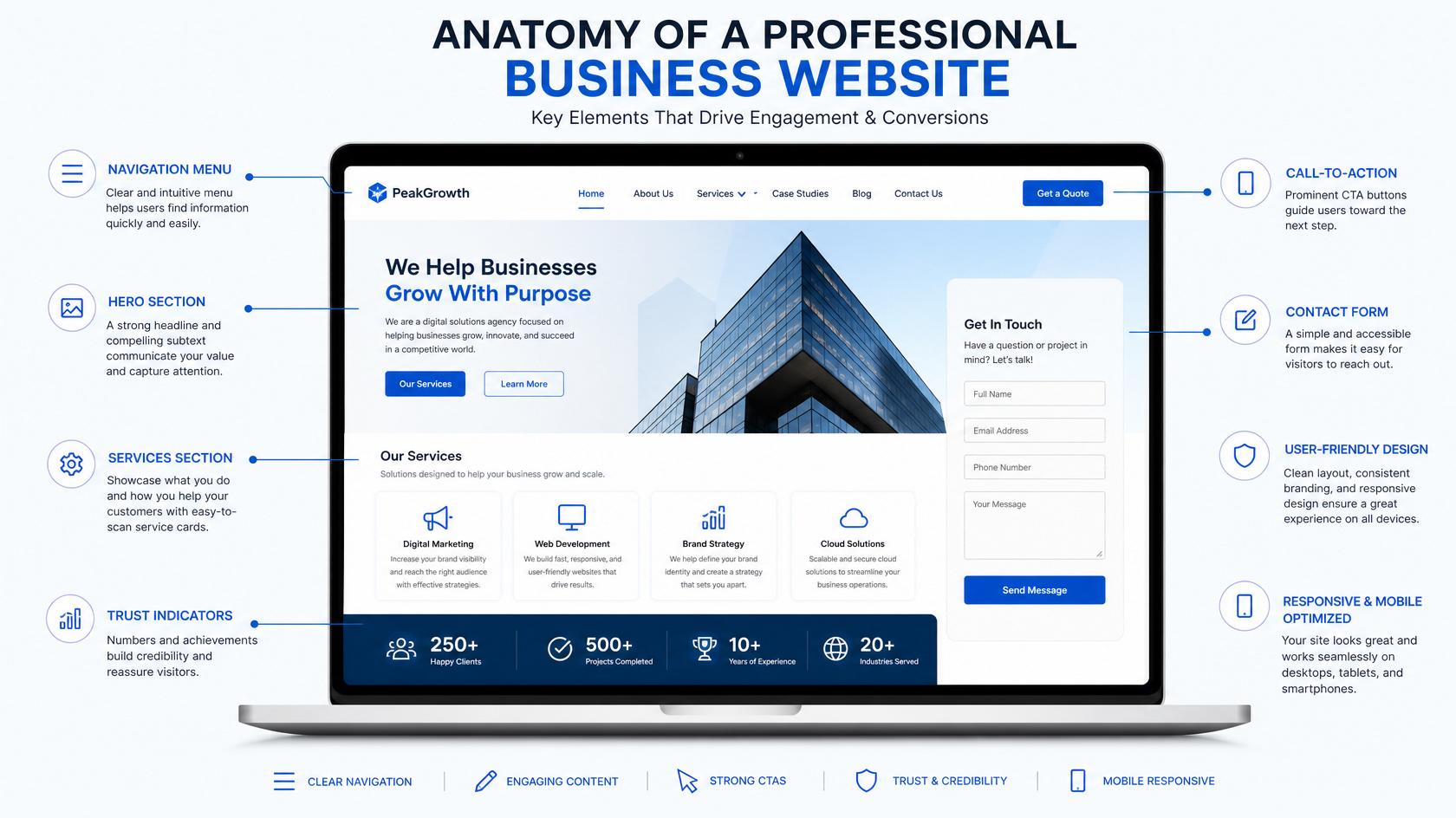
The homepage should quickly explain what the business does, who it serves and why a visitor should choose it. The main heading should be specific and supported by a short paragraph and a clear call to action such as Request a Quote, Book a Consultation, Call Now or View Services.
2. Well-Structured Service or Product Pages
Each important service should have a dedicated page with a clear explanation, benefits, process, common questions, proof and next step. Combining every service into one short page limits both customer understanding and search visibility. Product websites need useful categories, filters, accurate descriptions and clear purchasing information.
3. A Credible About Page
The about page should help customers understand the company’s experience, values, approach and people. Avoid generic claims that could apply to any business. Include relevant history, team information, certifications, locations, process and the type of clients the company supports.
4. Strong Trust Signals
· Genuine customer testimonials or case studies.
· Recognisable client, partner or accreditation logos where permission exists.
· Clear company contact details and business locations.
· Team profiles or responsible contact information.
· Project examples with an explanation of the work completed.
· Transparent policies, terms and service expectations.
5. Mobile-Friendly Responsive Design
Customers use different screen sizes and input methods. The website should provide readable text, comfortable spacing, clear menus, properly sized buttons, fast forms and stable layouts on mobile, tablet and desktop. Mobile-friendly website design is essential for usability, lead generation and search performance.
6. Fast and Reliable Performance
Large images, unnecessary scripts, poor hosting and excessive plugins can make a website feel slow. Professional development should include image optimisation, efficient code, caching, suitable hosting and performance testing. Speed improvements should focus on real pages and user journeys rather than a score alone.
7. SEO-Ready Page Structure
· Unique title tags and meta descriptions.
· One clear primary heading and logical supporting headings.
· Descriptive URLs and crawlable internal links.
· Useful, original content aligned with customer searches.
· Canonical tags, sitemap and robots settings.
· Structured data where relevant.
· Descriptive image alternative text.
· Location information for local or regional services.
You can run a quick technical check with the free WebCOSS SEO Meta Tag Analyzer at https://webcoss.com/tools/seo-meta-tag-analyzer.
8. Clear Calls to Action
Every important page should guide the visitor towards a useful next step. The call to action must match the page intent. A service page may request an enquiry, a product page may encourage purchase, and a resource page may invite the reader to view a related service.
9. Simple Contact and Enquiry Options
Provide a contact page with a short form, phone number, email address, location and opening information where relevant. Ask only for information that is genuinely needed. Forms should show clear success and error messages and should be tested regularly.
10. Frequently Asked Questions
FAQs can remove uncertainty about pricing, timelines, service areas, delivery, support and the project process. They are most effective when written from real customer questions and placed on the most relevant page rather than repeated identically throughout the site.
11. Legal, Privacy and Accessibility Information
A professional website should include appropriate privacy, cookie, terms and accessibility information for the business and market. Requirements vary, so businesses should obtain legal or compliance advice where necessary. Forms and tracking tools should be configured responsibly.
12. Content Management and Analytics
The team should be able to update important content without risking the website layout. Analytics, conversion tracking and search-performance tools should also be configured so decisions can be based on real user behaviour.
13. Maintenance and Security
A website needs ongoing software updates, backups, security monitoring, content reviews and performance checks. A clear maintenance plan protects the investment and helps the website remain reliable as browsers, devices and business requirements change.
Professional Website Checklist
· Clear message and target audience.
· Dedicated pages for core services.
· Responsive mobile experience.
· Fast loading and reliable hosting.
· Trust signals and project proof.
· Search-friendly technical foundations.
· Simple enquiries and strong calls to action.
· Analytics, ownership and maintenance plan.
Build a Better Business Website
WebCOSS designs responsive, secure and SEO-ready business websites for companies in the UK, India and international markets. Explore all digital services at https://webcoss.com/services or discuss a new business website.
Tell us about your project
Send the key details and WebCOSS will reply with practical next steps.
Need help planning or improving your digital platform?
WebCOSS can help translate your goals into a practical website, ecommerce, SEO or custom software roadmap.